Contents
2.1. Project Waste Policy Statement
4. Site Organisation and Staff Duties
4.2. Role and Responsibilities
4.2.1. Project Director / Project Manager
4.2.2. Construction Manager(s)
4.2.4. Environmental Supervisor
4.2.5. Engineers and Foreman (Frontline staff)
5.1. Waste Management Hierarchy and Waste Reduction
6.1. On-site sorting of C&D Material
6.4. System for Proper Control of Using Timber in Temporary Works
7. Waste Disposal Management and Procedure
7.2. Onsite Disposal Arrangement
7.3. Acceptance Criteria for Fill Bank (Tuen Mun Area 38 Fill Bank)
7.4. Acceptance Criteria for NENT Landfill
7.5. Acceptance Criteria for EPD approval licenced C&D material recycler
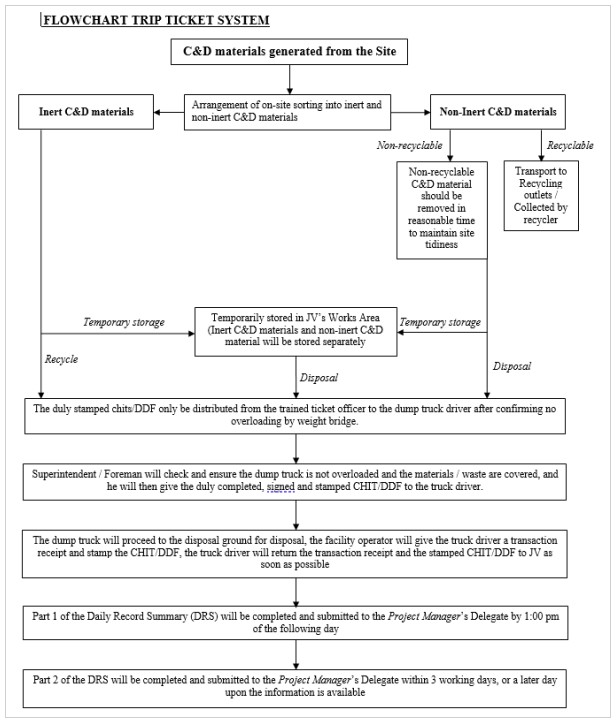
7.6. Procedures of the Trip Ticket System (TTS)
7.9. Disposal of C&D Material to Alternate Disposal Facilities and EPD Approved C&D Recycler
7.10. Chemical Waste / Hazardous Waste Handling and Disposal
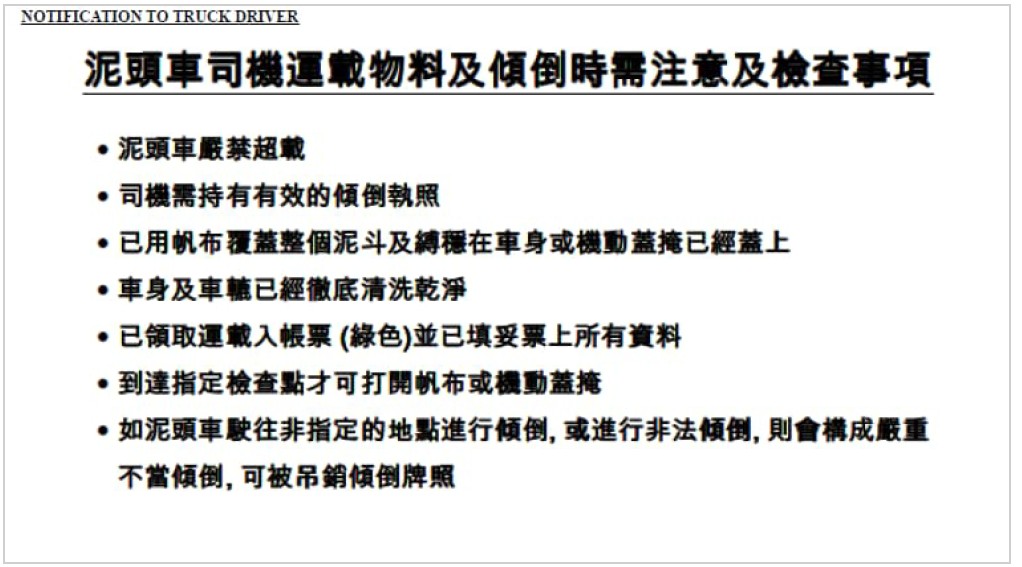
8. Notification to Truck Driver
9. Waste Monitoring and Action Plan
|
APPENDIX |
|
|
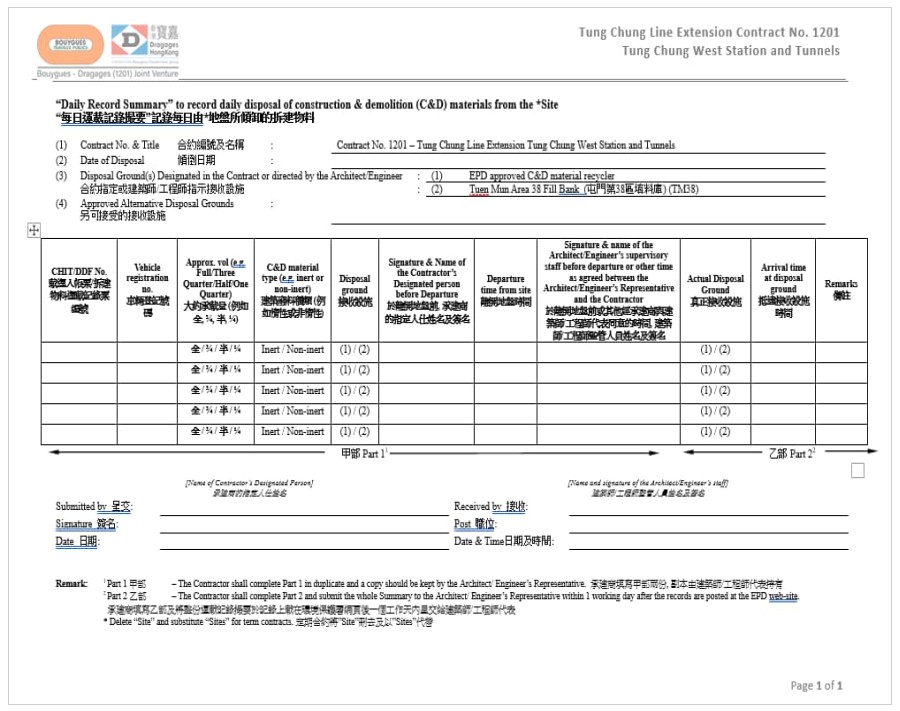
DAILY RECORD SUMMARY OF C&D MATERIAL TEMPLATE AND SAMPLE TRIP TICKET |
|
1. Introduction
1.1. Background
This Waste Management Plan details the construction works programme and location plans of Works to be deployed by Bouygues – Dragages (1201) Joint Venture (BDJV) during the construction works under Entrustment Agreement No. ENT/TUE/001.
The Environmental Impact Assessment (EIA) Report (Register No.: AEIAR-196/2016) pertaining to the "Tung Chung New Town Extension" project has been duly approved by the Director of Environmental Protection. Subsequently, an Environmental Permit (Permit No.: EP-519/2016) has been issued for the project in accordance with the Environmental Impact Assessment Ordinance. In compliance with Condition 2.24 of the Environmental Permit (EP), BDJV is mandated to formulate and submit a Waste Management Plan for the undertaking.
1.2. Scope of Works
The works mainly comprise:
a) Construction of Road L31 and associated works
b) Construction of Yu Tung Road footbridge lift
No surcharge operations are involved in this project.
2. Objectives of the WMP
This WMP will describe the arrangements for avoidance, minimization, handling, reuse, recovery and recycling, storage, transportation, collection, treatment and disposal of the different categories of waste that are expected to be generated during the construction activities of the Contract. This WMP includes the recommended mitigation measures on waste management that are contained in the EIA report and EM&A manual. The main objectives of the WMP include:
§ Providing reference to the waste management requirements;
§ Clarifying the responsibilities of each party on waste management and the personnel within the BDJV management; and
§ Establishing the waste management procedures for avoidance, minimization, material reuse/recovery/recycling, collection, transportation, storage and disposal of wastes generated from the activities of the Contract that are specified by EP and the implementation of the mitigation measures that outlined in the EIA report.
2.1. Project Waste Policy Statement
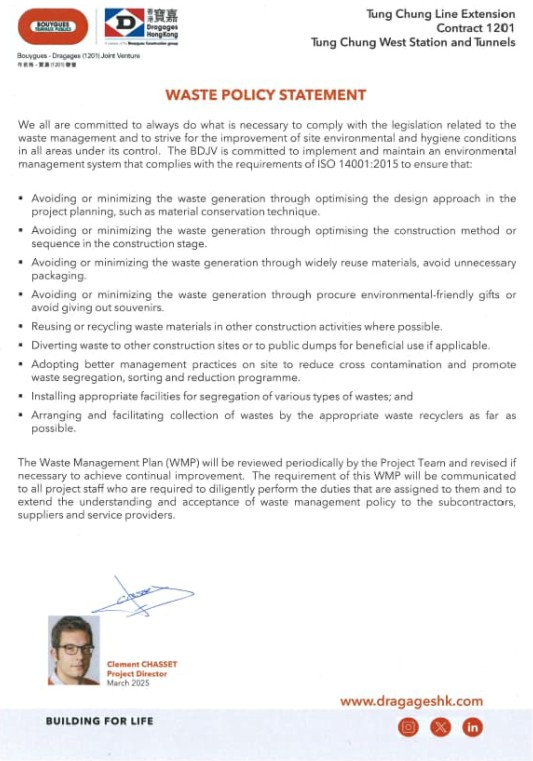
A Project Waste Policy Statement has been established to do at all time what is necessary to comply with the legislation related to the waste management and to strive for the improvement of site environmental and hygiene conditions in all area under its control. The BDJV’s Waste Policy Statement is presented in below.
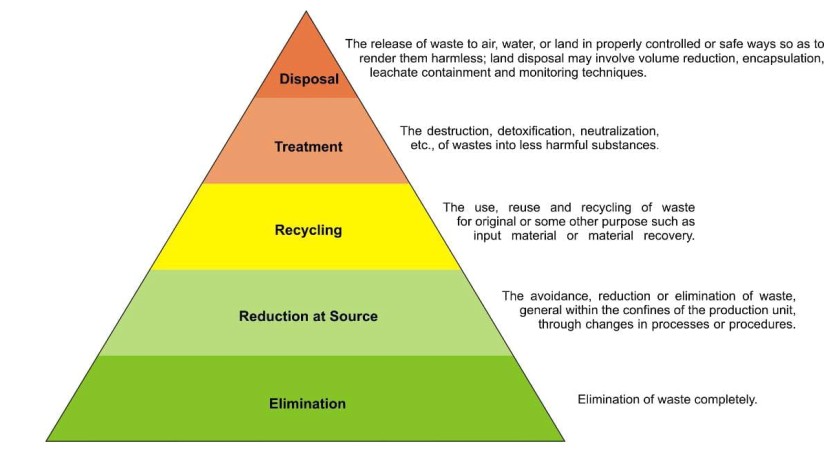
BDJV aims to recover, avoid and minimize the construction waste generated on site by utilizing the hierarchy illustrated below. And we target to recycle and reuse 100% of inert C&D material from excavation. This attempts to evaluate waste management practices and selects the best practical option since conceptually it makes sense to avoid producing a waste rather than developing extensive treatment schemes. Through good planning, and effective site management practices, BDJV will minimise the amount of construction waste that is generated. The objective of BDJV is to reduce and minimize the amount of wastes generated and hence minimise the costs associated with subsequent waste handling and disposal
3. Ordinances and Regulations
The following environmental ordinances and regulations are relevant to waste
management on the Site:
§ Waste Disposal Ordinance, Cap. 354
§ Waste Disposal (Chemical Waste)(General)Regulation
§ Waste Disposal (Charge of Disposal of Construction Waste) Regulation
§ Dumping at Sea Ordinance, Cap. 466
§ Land (Miscellaneous Provisions) Ordinance, Cap. 28
§ Public Health and Municipal Services Ordinance, Cap. 132
§ Public Cleansing and Prevention of Nuisances Regulation
The following environmental ordinances and regulations are relevant to waste management on the Site:
§ Waste Disposal Plan for Hong Kong (December 1989)
§ Chapter 9 Environment (1999), Hong Kong Planning Standards and Guidelines
§ New Disposal Arrangements for Construction Waste (1992)
§ Code of Practice on the Packaging, Labeling and Storage of Chemical Wastes (1992)
§ Works Branch Technical Circular (WBTC) No. 32/92, The Use of Tropical Hard Wood on Construction Site
§ WBTC No. 2/93, Public Dumps
§ WBTC No. 2/93B, Public Filling Facilities
§ WBTC No. 16/96, Wet Soil in Public Dumps
§ WBTC No. 4/98 and 4/98A, Use of Public Fill in Reclamation and Earth Filling Projects
§ Waste Reduction Framework Plan, 1998 to 2007
§ WBTC No. 25/99, 25/99A and 25/99C, Incorporation of Information on Construction and Demolition Material Management in Public Works Subcommittee Papers
§ WBTC No. 12/2000, Fill Management
§ WBTC No. 19/2001, Metallic Site Hoardings and Signboards
§ WBTC No. 6/2002 and 6/2002A, Enhanced Specification for Site Cleanliness and Tidiness
§ WBTC No. 11/2002, Control of Site Crusher
§ WBTC No. 12/2002, Specification Facilitating the Use of Recycled Aggregates
§ ETWBTC No. 33/2002, Management of C&D Material Including Rock
§ PAH No. 6/2025, Management of Dredged / Excavated Sediment
§ ETWBTC No. 31/2004, Trip Ticket System for Disposal of C&D Materials
§ ETWBTC No. 19/2005, Environmental Management of Construction Site
§ DEVBTC No. 6/2010, Trip Ticket System for Disposal of C&D Materials
4. Site Organisation and Staff Duties
4.1. Organization Structure
The organization structure for waste management onsite is outlined in Figure 2.1. This structure outlines the overall site management in relation to waste management and the associated environmental issues. Details on the roles and responsibilities of staff members responsible for the implementation of the WMP are outlined in the BDJV organizational chart for waste management below:
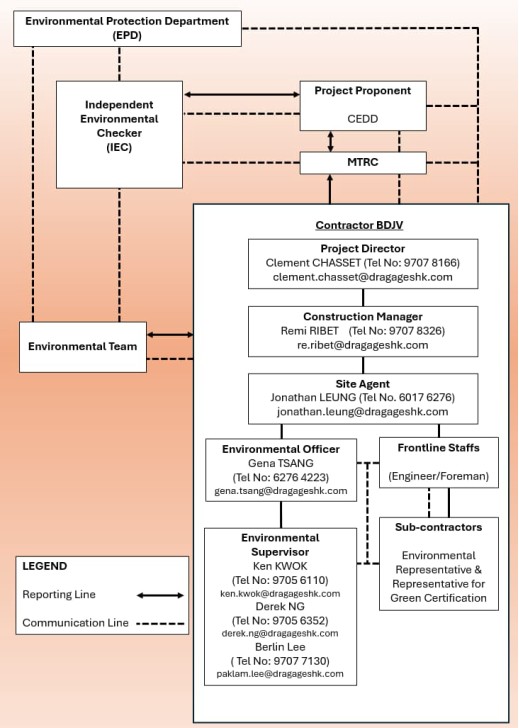
Figure 2.1 Organization structure
4.2. Role and Responsibilities
4.2.1. Project Director / Project Manager
The Project Director (PD) or Project Manager (PM) is responsible for coordinating all environmental matters on site and reporting on these matters to the BDJV. Approve (internally) the WMP and ensure adequate resources for the implementation of the WMP.
4.2.2. Construction Manager(s)
Construction Manager (CM) reports to the PD and has the responsibility to coordinate all environmental matters related to the WMP. The CM is also responsible for all site operations, management of environmental issues, staff supervision, control, coordination & planning, external liaison as well as implementing and monitoring corrective actions related to the WMP.
The CM, when necessary, will also carry out immediate corrective action to rectify any non-compliance of environmental requirements of the WMP, as well as handle any complaints that are received from the public regarding the WMP.
The CM will also assist the EO in overseeing the implementation and performance of the WMP. The CM would also assist with environmental duties onsite and ensure that works are executed in accordance with the WMP. The CM will arrange regular site inspections with the EO.
4.2.3. Environmental Officer
The EO will be appointed on site for the overall coordination, monitoring, oversight and implementation of the WMP for the duration of the contract. The EO directly reports to the PD and DPD. The responsibilities of the EO include, but are not limited to:
§ Review of the Site Management Plan for Implementation of the TTS and ensure works are executed in accordance with the plan.
§ Monitor onsite work to ensure compliance with the environmental requirements for the site.
§ Assist the CM in handling any complaints that are received.
§ Ensure that the required environmental monitoring is carried out, and that all environmental monitoring results are recorded.
§ Carrying out waste management training.
4.2.4. Environmental Supervisor
The Environmental Supervisor (ES) is responsible for the implementation of the WMP with the assistance of the Foremen. The ES is also responsible for:
§ Assisting the EO to rectify any non-conformances with the environmental requirements of this WMP that are identified onsite.
§ Attend environmental meetings related to waste management when necessary.
§ Carry out environmental site inspections with the EO when deficiencies in waste management are identified.
Assist the EO with any environmental accidents, such as the release of chemicals.
4.2.5. Engineers and Foreman (Frontline staff)
The Senior Engineer/ Engineer and Foremen are responsible for onsite supervision, the coordination of the works as well as the implementation of any corrective actions as directed by the CM/EO. They are also responsible for:
§ Coordinate with the EO regarding the implementation of all appropriate environmental mitigation measures and waste management.
§ Coordinate with the EO to make sure that all the applicable environmental licenses and permits are identified and allowed for in the program of work.
§ Assisting in the daily implementation of the WMP including the sorting and segregation of construction waste in to separate stockpiles/staging areas and where possible the recycling (via recycling containers) or reusing materials.
§ Ensuring that the trip-ticket system is followed and that all paperwork (e.g. CHIT / Disposal Delivery Form (DDF)) is signed, completed and collected.
§ Ensuring that, where possible, the generation of waste is avoided or minimized.
4.3. Trainings and Promotions
Site-specific induction training cover environmental matters, including waste management shall be presented to all staff and workers employed for the Contract, whether in the employment of BDJV or his sub-contractors or in connection with the Contract. The training will be delivered by the Environmental Officer, Environmental Supervisor or assigned person, as applicable as per construction programme. The training content will cover subjects such as environmental management policy, waste management policy, project environmental organization structure, duties and responsibilities, waste control measures, disposal targets, in-house rules and regulations, mechanical cover requirement, disposal sites …etc.
Apart from the induction training, toolbox talks shall be provided for workers on general site environmental nuisance abatement and waste management in addition to safety and health. Prior approval will be obtained from the Project Manager’ delegate on the frequency and the contents of the toolbox trainings. If further required by the Project Manager’ delegate, trainings organized by training institutes or organizations as considered appropriate will be arranged.
Method of promoting and maintaining the awareness on environmental aspects and its control measures and waste management amongst all persons on Site include:
§ Display of the company’s environmental policy, non-compliance statistics, posters and signs at prominent locations;
§ Talks and campaigns, and distribution of safety/environmental bulletins or newsletters drawing attention to the particular environmental issues; and
§ Procedures for recognition and commending those site personnel, teams or sub-contractors with good performance on environmental control measures and waste management.
5. Waste Management
Control of construction and demolition (C&D) waste is fully detailed in the following paragraphs and the Waste Management Plan for trip tickets implementation.
5.1. Waste Management Hierarchy and Waste Reduction
The key to successful waste management is undertaking proactive measures to reduce the amount of waste generated. Waste management options/programme will be exercised in accordance with the hierarchy outlined in Table 5.1 below:
Table 5.1: Hierarchy/Programme of Waste Management
|
Waste
Management Option/Programme |
Required
Actions |
|
|
Avoidance
/ Reduction / Minimization |
Avoid
the generation of excessive waste by planning and scheduling material
deliveries. Minimize
the amount of waste generated through careful planning and design, before
commencing the contract. |
|
|
Re-use |
Where
appropriate and practicable, construction materials such as timber formwork,
metal, etc, and any spoil generated during excavation work should be re-used
onsite. |
|
|
Recovery and
Recycling |
Recyclable
construction materials such as plastics and metal will be recovered, sorted
and stored onsite in containers. The containers will be transported off
site for recycling at an approved facility. Regularly
serviced, covered recycling containers will be provided for the use of the
onsite workforce. |
|
|
Treatment and
Disposal |
All
waste removed from the site requiring treatment and/or disposal will be
transported to an approved facility. |
|
To achieve waste reduction, environmentally responsible purchasing would involve the introduction of practices that discourage unnecessary purchases and encourage the purchase of products or materials that can be found locally, that have reduced packaging or recyclable packaging, increased durability and materials with recycled content, such as, recycled paper, steel, concrete and other raw construction materials.
Waste minimization is best achieved through the use of careful planning, design and close supervision. It is expected that, following good waste management practices on site will result in a reduction of the amount waste being generated. To minimize the wastage of raw materials that are delivered to the site, good management, estimation and planning techniques will be required.
6. Waste Reduction Programme
6.1. On-site sorting of C&D Material
BDJV will designate suitable areas onsite for the storage, sorting and segregation of construction waste. The areas that are designated by BDJV will be clearly defined with appropriate signage and barriers (or similar) and allow for easy access by workers and vehicles. As the project progresses, the designated areas will be reviewed depending upon construction program requirements. The areas designated by BDJV will be sufficient for the amounts of construction waste that are anticipated to be generated during the course of the contract. Table 6.1 below shows the actions that will be taken for each type of construction waste generated onsite.
Table 6.1: Sorting of C&D Waste
|
Type of C&D Material |
Required Action |
Responsible Party |
|
Rock |
Re-use on
site where possible or recycle off site |
BDJV |
|
Excavated
material |
Re-use on
site where possible or dispose of at approved landfill facility |
BDJV/
Subcontractors |
|
Concrete |
Sorted
and segregated onsite, minimize wastage by accurate ordering, re-use on site
where possible or recycle offsite |
BDJV/
Subcontractors |
|
Metal |
Segregate
and recycle offsite |
BDJV/ Subcontractors |
|
Paper/ Cardboard
Materials |
Segregate
and recycle offsite |
BDJV/
Subcontractors |
|
Plastics |
Use
recycling containers for temporary storage and recycle offsite / Reuse /
Replaced by other materials |
BDJV |
|
Aluminium
Cans |
Use
recycling containers for temporary storage and recycle offsite |
BDJV |
|
Timber |
Re-use on
site if possible, other segregate and recycle off site |
BDJV/
Subcontractors |
|
Chemical
Waste |
Store in
approved containers and transport offsite for disposal at an approved
facility |
BDJV/ Subcontractors |
Reusable or recyclable materials such as hard rock, broken concrete, metallic waste, timber, paper as well as cardboard packaging will be separately sorted out and pre-identified on-site at different area, for easy collection of those materials by recyclers.
Arrangements with potential recycling contractors shall be made to facilitate that recyclable materials sorted from the Site are collected with reasonable care.
6.2. Recyclable Materials
Control measures would be devised to ensure that the recyclable materials are delivered to a proper recycling outlet for processing, and to avoid such materials being considered as C&D materials for the purposes of the Contract. Trip ticket system is not applicable to recyclable materials. However, the invoice, receipt or disposal records will form parts of the comprehensive register as described in the previous section to ensure integrity of disposal records. The monthly quantities of the recyclable materials removed off site will be recorded in the waste flow table for monthly submission to the Project Manager’s delegate.
C&D waste generated from construction activities will be basically on-site sorted to inert and non-inert. For the inert portion, it will be collected and stored separately from other non-inert materials to prevent cross-contamination. About the non-inert portion, recyclable materials such as plastics, aluminium cans and cardboard will be collected and stored separately for other non-recyclable materials.
Specific measures will be implemented to reduce the generation of waste materials, and thus minimize the amount of waste disposal to landfills. The measures will include:
§ Sort all excavated materials and recover the inert portion of C&D materials, such as hard rock, soil and broken concrete, for reuse on the Site or, if cannot be used on the Site, disposal to designated outlets for reuse;
§ Sort reclaimed asphalt pavement (RAP) out from other inert C&D materials for reusing on-site or when delivered to the PFRFs;
§ recover all metallic waste for recycling;
§ recover cardboard and paper packaging, and properly stockpile them in dry and covered condition to prevent cross contamination; and
§ sort all demolition debris to recover reinforcement bars, mechanical and electrical fittings, hardware and all other fittings/ materials that have established recycling outlets.
6.3. Waste Reduction Targets
In order to determine whether the waste management procedures used by BDJV are effective, the following specific targets will be implemented onsite in an effort to reduce the generation of waste materials, and thus minimize the amount of waste requiring disposal at landfill:
§ 100% of reuse and recycle to all inert C&D material. All excavated material will be sorted on site to recover the inert portion of construction and demolition debris materials, such as hard rock, soil and broken concrete, for subsequent re-use on site or disposal to designated outlets.
§ Recover and store all metallic waste (e.g. scrap metal) for subsequent collection by a recycling contractor and recycling at an approved facility.
§ Recover all cardboard and/or paper packaging (for plant, equipment and materials) and store in covered stockpiles (to keep dry and prevent contamination) for subsequent collection and recycling at an approved facility, if possible.
§ All chemical waste that is generated on site (e.g. servicing of plant) will be stored for collection and disposal at an approved disposal facility.
§ All demolition debris will be sorted on site to recover broken concrete, reinforcement bars, mechanical and electrical fittings, hardware as well as other recyclable fittings for subsequent recycling at an approved facility.
§ The use of timber formwork shall be avoided when practicable and alternatives such as steel formwork shall be considered and used to increase the potential for re-use. Timber hoarding shall not be Instead of wooden pallets for material delivery, the use of plastic re-usable pallets shall be encouraged by BDJV with its discussions with suppliers. When timber is required for the works, it will be selected whenever practicable from managed sources.
6.4. System for Proper Control of Using Timber in Temporary Works
In order to control the quantity of using timber in temporary works, controlling system will be implemented:
§ Use of timber in temporary works shall be reduced or minimized as far as practicable; for example, pre-cast concrete elements or steel formwork which will reduce the quantity of timber required for formwork. Timber pallets when delivered to site will be carefully handled so that they may be reused.
§ The design of formwork shall maximize the use of standard panels so that high re-use levels can be achieved. Timber formwork shall be carefully dismantled to prevent damage. The timber shall be de-nailed, cleaned and stacked neatly for re-use. Wooden pallets for material delivery may be returned to the supplier for re-use.
§ Review construction method statements to estimate and control of use of timber, and use of alternative materials to place timber for temporary works.
6.5. Good Site Practices
BDJV will follow some good site practices to reduce the adverse waste issues such as:
§ cleaning and maintenance for drainage systems, sumps and oil interceptors shall be carried out once per week or if necessary;
§ regular collection of waste at disposal points, etc.
7. Waste Disposal Management and Procedure
7.1. General
The waste that is generated during the construction process will be disposed to designated disposal facilities. Monthly summaries of the amount of waste material disposed offsite will be provided to the Project Manager’s delegate in the form of a Waste Flow Table (WFT). The summaries will indicate the estimated quantities of different types of waste removed offsite and the corresponding disposal ground in the WFT.
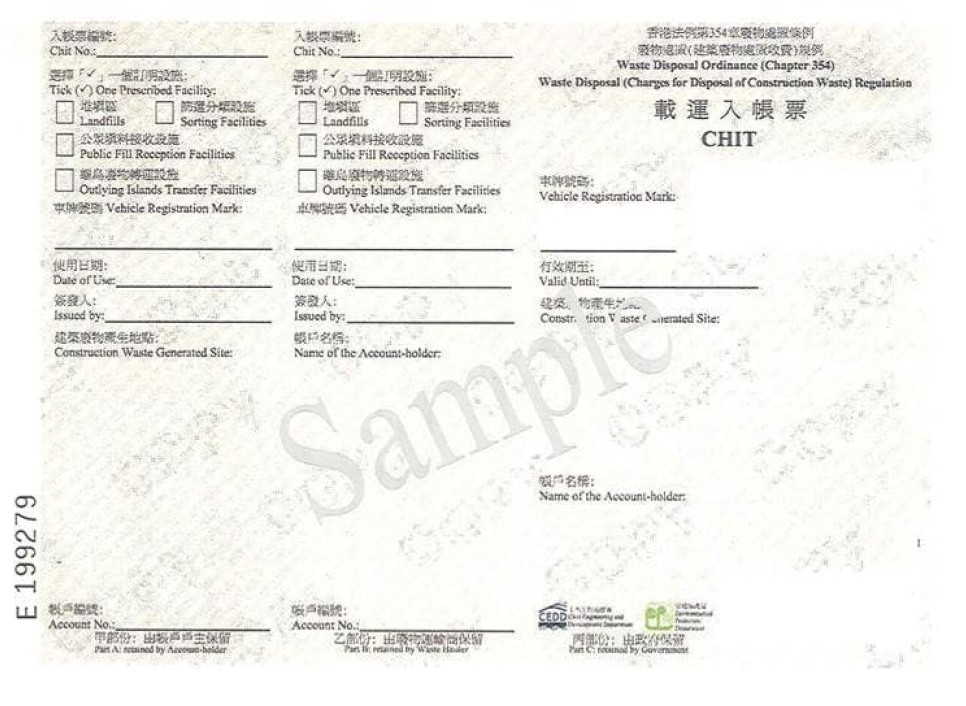
The quantities of C&D material disposed of will be recorded under the barcode TTS by using the CHIT / DDF (for disposal of Inert C&D Materials at disposal grounds (Other than Prescribed Facilities) as designated in the Contract, or alternative disposal grounds proposed by the Contractor and approved by the Project Manager’s delegate). In addition, a completed "CHIT" will also be presented to the receiving facility as part of the system for the disposal charging scheme. Waste transaction records could be obtained either from the waste disposal facilities directly or retrieved from the EPD website or bill statement.
7.2. Onsite Disposal Arrangement
The recommended waste disposal sites are listed in Table 7.1 below:
Table 7.1 Recommended Waste Disposal Sites
|
Type of Waste |
EIA recommended Disposal Site
|
|
C&D materials |
Tuen Mun Area 38 (TM 38) Fill Bank
|
|
C&D waste (plastics, glass, wood, including cleared vegetation etc.) |
Recycler |
|
Chemical waste (as defined under Schedule 1 of the Waste Disposal (Chemical Waste) Regulation) |
Licensed chemical waste treatment and disposal facility |
|
General refuse |
NENT Landfill
|
Alternative disposal facility is recommended to perform local matching of inert C&D material to other Project, to minimise C&D disposal to Public Fill.
Inert C&D material in liquid form will be solidified so that it can be contained and delivered to PFRFs by dump trucks instead of tanker trucks.
In order to reduce the disposal of C&D material to fill bank activities, BDJV is intent to maximize and target 100% reuse and recycle of C&D material from the project, and one of the proposed option is to recycle as far as practicable for all inert C&D material generated from our constriction works by EPD approved licenced C&D material recycler "Tapbo Environmental Ltd", which include recuse of all rock material and reuse all other inert material for concurrent project, for example use as capping layer at NENT landfill.
When there is no other alternative disposal site accepted by the client, the last resort will be disposed to TM38 Fill Bank as mentioned in section 7.2. Non-inert C&D materials is proposed to be disposed in public landfills. BDJV will comply with the acceptance criteria laid down by the operators of the corresponding fill bank(s) and landfill(s), as outlined in Section 7.3 and 7.4 below.
7.3. Acceptance Criteria for Fill Bank (Tuen Mun Area 38 Fill Bank)
The truck drivers should bear a duly signed CHIT / a duly completed, signed and stamped DDF. The dump truck should also have a valid Dumping Licence issued by CEDD. Dump trucks without valid Dumping Licences will be rejected.
The inert C&D materials to be delivered to the fill bank(s) should be in accordance with the conditions stipulated in the Dumping Licence. The C&D materials to be disposed should consist entirely of inert construction waste (i.e. 100% inert construction waste). Moisture content of the inert C&D materials should be lowered to 25% max. when delivered to public fill banks. And reclaimed asphalt pavement (RAP) should not be mixed with other materials when delivered to public fill banks. The size of any C&D materials sent to PFRFs should be less than 250mm.
Recyclable materials such as metal, paper, plastics and milled bituminous materials etc., which have been sorted on the site for the purposes of recycling, shall not be considered as C&D materials and should be delivered to a proper recycling outlet for processing. Recycling contractors will be arranged to collect the recyclable materials.
7.4. Acceptance Criteria for NENT Landfill
The truck drivers should bear a duly signed CHIT. The dump truck should also have a valid Dumping License issued by CEDD. Dump trucks without valid Dumping Licenses will be rejected.
The non-inert C&D waste to be delivered to the landfills should be in accordance with the conditions stipulated in the Dumping License.
Construction waste containing not more than 50% by weight of inert C&D waste (Gazette Notice G.N. 4274 published on 16 June 2008).
For a load of C&D waste not consisting entirely of bamboo, plywood or timber delivered by a vehicle, the weight of the waste divided by the permitted gross vehicle weight of the vehicle must not greater than 0.25 for goods vehicle with demountable skip and 0.2 for other types of vehicles (Gazette Notice G.N. 4274 published on 16 June 2008). The depth of waste loaded on the goods vehicle, or any other vehicle must be greater than 1 meter for goods vehicle with demountable skip and 1.5 meters for any other types of vehicle.
Mixed C&D materials should be sorted at source to reduce the inert content as far as practicable to meet the above criteria before they are delivered to landfills.
C&D waste delivered for landfill disposal should contain no free water and the liquid content will not exceed 70% by weight.
7.5. Acceptance Criteria for EPD approval licenced C&D material recycler
The truck drivers should bear a duly completed, signed and stamped DDF (for approved alternative disposal grounds). The dump truck should also have a valid Dumping Licence issued by CEDD. Dump trucks without valid Dumping Licences will be rejected.
The inert C&D materials to be delivered to the C&D recycler should be in accordance with the conditions stipulated in the Dumping Licence. The C&D materials to be disposed should consist entirely of inert construction waste (i.e. 100% inert construction waste).
Recyclable materials such as metal, paper, plastics and milled bituminous materials etc., which have been sorted on the site for the purposes of recycling, shall not be considered as C&D materials and should be delivered to a proper recycling outlet for processing. Recycling contractors will be arranged to collect the recyclable materials.
7.6. Procedures of the Trip Ticket System (TTS)
Under the Waste Disposal (Charges for Disposal of Construction Waste) Regulation, BDJV will apply for a vehicle billing account for disposal of construction waste.
We will implement a TTS to track the disposal of C&D materials. Under the TTS, each truck carrying C&D materials leaving the Site for a Government disposal facility will be accompanied by a duly completed and stamped CHIT. The C&D materials must be disposed of at the disposal grounds as stipulated in the DDF. The TTS will be executed according to the following procedures:
The Foremen will arrange the C&D waste to be segregated on site and also check the total actual amount of cumulated C&D waste after the completion of the particular works in the working area.
The C&D waste will be sorted and stored separately into different storage areas.
Non-inert C&D waste will be stored in waste receptacles at a temporary holding area. Inert C&D materials will be stored on a temporary holding area enclosed by water barriers or rigid concrete barriers.
For each load on truck of C&D material leaving the working area to the designated fill banks / landfills, the truck driver must bear a duly completed, signed and stamped CHIT. A Notification to Truck Driver (attached in Appendix C) will be given to truck drivers to remind them the proper disposal procedures.
The truck will proceed to the designated disposal facility as stipulated in the CHIT. The truck driver will present the CHIT to the reception facility operator. If the C&D waste accords with the acceptance criteria, disposal of the C&D waste will be permitted and the facility operator will give the truck driver a transaction receipt and stamp the CHIT.
The truck driver will present the CHIT at the weighbridge. If the vehicle load is accepted, the CHIT is deemed to be used and the weight would be recorded on the "Transaction Record Slip".
If the truck driver is instructed by the reception facility operator to go to the sorting facility, the driver will need return back to the site and report to the Foremen. No driver is allowed to go to sorting facility without Foremen permission or instruction.
The truck driver will then return the transaction receipt and the stamped CHIT to BDJV as soon as possible. All CHITs are to be returned to the EO or ES.
BDJV will maintain a daily record summary (DRS) of disposal of C&D material from the Site including details of the C&D waste, the truck number, departure time, etc. This record will be checked against the PMD records as soon as possible and the PMD will be notified immediately in case any discrepancy is noted.
Part 1 of the DRS will be completed in duplicate and a copy should be kept by the PMD.
For disposal at government disposal facilities, BDJV will check the information recorded in the DRS against the disposal records on the EPD’s website (see below).
http://www.epd.gov.hk/epd/misc/cdm/trip.html
Part 2 of the DRS will be completed and submit to the PMD within 1 working day after the records are posted at the EPD website.
Where an irregularity is observed or where requested by the PMD under special circumstances (e.g. a CHIT has been issued but there is no disposal record at the disposal ground), BDJV will submit to the PMD within 5 working days after the recorded date of disposal the supporting evidence such as duly stamped CHIT and/or the Transaction Record Slip (where relevant) to confirm proper completion of the delivery trips in question, or within 2 working days after the PMD has requested for such evidence, whichever is later. A fax copy of the CHIT or Transaction Record Slip is acceptable, unless otherwise directed by the PMD.
A Trip Ticket Management System (either via land transportation) and relevant transportation arrangement shall be developed and agreed with the alternative disposal project(s) and get approval from PMD if alternative disposal ground is proposed.
7.7. Measures to be Implemented during Transportation of Waste to Avoid Leakage of Waste onto Public Area
All trucks to transport waste from the site will be in good working condition and will be equipped with mechanical covers (or similar) to prevent leakage of waste onto public areas. In addition to the cover, to further minimize the leaking of waste from the trucks, trucks should not be filled higher than the trail board.
Wastes collected on all the wheels and bodies of trucks will be washed off by wheel washing facilities before leaving the construction site. BDJV will provide wheel washing facilities on site at the site entrance.
7.8. GPS
Pursuant to Section 2.24 of Environmental Permit EP-519/2016, all dump trucks for C&D materials transportation and disposal shall be equipped with Global Positioning System (GPS) or equivalent automatic system for real time tracking and monitoring of their travel routings and parking locations in order to avoid illegal dumping or landfilling of C&D materials. BDJV will ensure that C&D material is disposed at designated location.
The GPS tracking system installed on dump trucks transmit monitoring data to management system via mobile network in 30 seconds time interval when the dump truck engine is ON and 60 minutes time interval when the engine is OFF. The real time tracking and monitoring system provides a platform to BDJV to carry out inspection of the location and direction of dumping in webpage and mobile phone app. The configuration of the real time tracking system is shown below in Figure7.1.
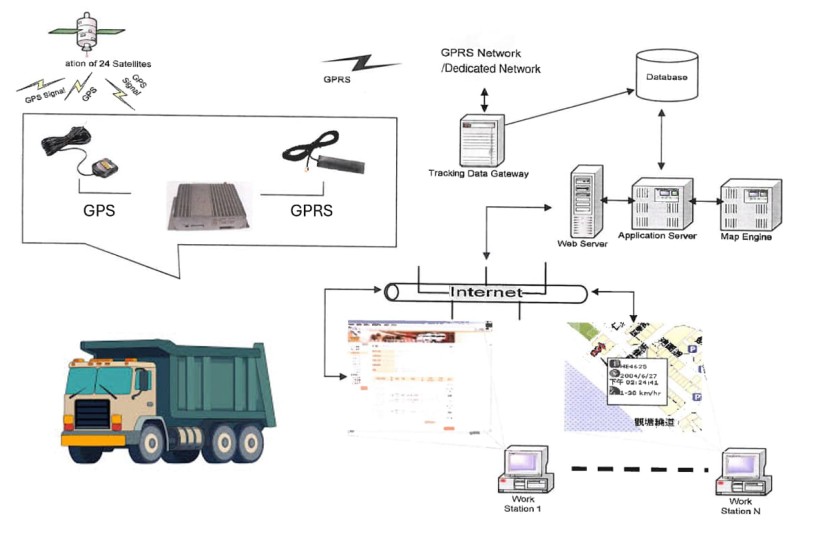
Figure 7.1 – Real time tracking system configuration
To ensure all C&D materials are disposed at the designated locations, the GPS monitoring system will automatically generate an alert via email to all relevant parties (such as ET, IEC, contractor, and surveillance team) if any dump trucks are not following the designated route or going into restricted zones for follow-up on any suspected irregularities or illegal dumping. The restricted zones are defined by a geofences created from certain points on the map. These automatic notifications will include important information details like the vehicle’s license plate, event time, and location. Prohibited areas, such as the Tung Chung Road (south of Shek Mun Kap Road and all roads in south Lantau) or any other zones marked as restricted in Tung Chung, can be monitored using real-time tracking and monitoring system. If any irregularities or non-compliance are identified, an email notification will be sent immediately to ET, IEC, contractor, surveillance team, or other relevant personnel. The notification emails and disposal records will be reviewed by the EO/ES to confirm that all dump trucks traveled to the designated disposal site after leaving the construction site.
7.9. Disposal of C&D Material to Alternate Disposal Facilities and EPD Approved C&D Recycler
Where BDJV has identified a project that can serve as an alternative disposal facility or reuse of C&D material at EPD approved C&D recycler recycler, BDJV will provide a detailed description of the alternative disposal ground, including location, lot number (where appropriate) and location plan(s) to the PMD to request for his written approval to dispose of waste at the proposed location.
If in case the alternative disposal facility is a private construction project, BDJV will submit a letter from the Authorized Person of the development (as defined under the Building Ordinance) to confirm that:
§ The use of C&D materials in the development is acceptable.
§ The use of land formed by C&D materials is in conformity with the statutory town plan / lease conditions.
§ The PMD is allowed to enter the alternative facility to conduct an inspection when necessary.
§ The estimated quantity and type of C&D materials to be used in the construction works and the approximate delivery program, together with the name, post and specimen signature of the competent person to sign the internal trip ticket.
Where the alternative disposal facility is a private facility but not a construction site, BDJV will submit a letter from the relevant authorities, such as the Lands Department and Planning Department, to confirm the suitability of the alternative disposal facility to receive the proposed amount of C&D materials for use, and a written consent from the landowner.
Where the alternative disposal facility is a government project, BDJV will submit written consent from the project office of the alternative disposal facility to use the C&D materials generated from the Site, and to confirm the estimated quantity and type of C&D materials required and the approximate delivery programme.
A system for transmitting disposal records from the alternative disposal ground will be submitted to the PMD for approval before disposal to the alternative ground starts.
With an option to recycle our C&D material at EPD licensed recycler (Tapbo Environmental Limited"), Under the requirement of EPD, Tapbo Environmental Limited also implement recording and trip ticket system, BDJV will implement the trip ticket system with relevant DDF provided by Tapbo Environmental Limited and detail disposal record will also be provided regularly including quantities and type of C&D disposal. the chit ticket procedure mentioned in Section 7.6 will be followed, and chit ticket of the EPD approved recycler will be adopted
7.10. Chemical Waste / Hazardous Waste Handling and Disposal
BDJV has been registered as Chemical Waste Producer. Chemical waste that is generated, as defined by Schedule 1 of the Waste Disposal (Chemical Waste) (General) Regulation, will be handled in accordance with the Code of Practice on the Packaging, Labelling and Storage of Chemical Wastes as follows:
Packaging
Chemical waste will be packed and held in containers of suitable design and construction so as to prevent leakage, spillage or escape of the contents under normal conditions of handling, storage and transport.
Containers used for the storage of chemical wastes will:
§ Be suitable for the substance they are holding, resistant to corrosion, maintained in a good condition, and securely closed.
§ Have a capacity of less than 450 litres unless the specifications have been approved by the EPD.
§ Display a label in English and Chinese in accordance with instructions prescribed in Schedule 2 of the Regulations.
Labelling
Every container of chemical waste will bear an appropriate label which with details of the chemical waste. The waste producer will ensure that the information contained on the label is accurate and sufficient so as to enable proper and safe handling, storage and transport of the chemical waste.
Storage
The storage area will be specially constructed and bunded, and located close to the source of waste generation. The storage area for chemical wastes will:
§ Be clearly labelled and used solely for the storage of chemical waste.
§ Be enclosed on at least three (3) sides.
§ Have an impermeable floor and bunding of sufficient capacity to accommodate 110% of the volume of the largest container or 20% of the total volume of waste stored in that area, whichever is the greatest.
§ Have adequate ventilation.
§ Be covered to prevent rainfall entering (water collected with the bund must be tested and disposed of as chemical waste).
§ Be arranged so that incompatible materials are adequately separated.
§ Before reaching 80% capacity of the storage container, licensed waste collectors will be contracted to remove the chemical waste.
Transportation and Disposal
After the chemical wastes have been packed, labelled, and stored, the chemical wastes will be transported by licensed waste collectors and disposed of at Chemical Waste Treatment Facility in Tsing Yi or other approved facilities.
7.11. General Refuse
Measures to be implemented to encourage general waste avoidance / minimization include:
§ Reducing the number of photocopies to a minimum and copying on both sides of paper for internal documents and external documents where appropriate.
§ Preventing over-ordering of office equipment and consumables.
§ Procuring energy efficient office equipment and consumables.
§ Deploying and servicing recycling containers on site to facilitate collection of recyclables (e.g. aluminium cans, plastic bottles).
§ Deploying containers with covers onsite to facilitate the collection of non-recyclables for disposal at landfills.
7.12. Sewage
Sewage waste will be generated from amenity facilities used by the construction workforce and site office’s sanitary facilities. Such sewage waste will be treated by a sewage treatment system to minimize the volume of waste. The treated sewage sludge will be pumped out by suction trucks and disposed off site.
Night soil from chemical toilets will also be generated. The sludge needs to be properly managed to minimise odour and potential health risks to the workforce by attracting pests and other disease vectors.
As the workers will be scattered within the construction site, the most cost-effective solution will be to provide adequate number of portable toilets within the site to ensure that sewage from site staff is properly collected. BDJV will ensure adequate numbers of portable toilets for the workforce and ensure no adverse water impacts by contracting with licensed contractors to maintain the facilities.
7.13. Handling of Recyclables
Before starting the transportation of recyclable materials off site to recycling facilities, BDJV will meet with recycling contractors to establish a suitable system for collecting recyclable materials with care.
The following types of waste will be generated during the construction of the Contract.
§ General Waste.
§ Non-inert C&D materials.
§ Inert C&D materials / waste.
§ Chemical waste.
§ Recyclable waste.
The estimated amount of waste to be generated from the whole Contract is listed in Table 7.2 below:
Table 7.2: Estimated Amount of Waste to be Generated During the Contract
|
Material |
Generated from Project (m3) |
Re-used/ Recycled onsite or on other Projects (m3) |
Disposal (m3) |
Proposed Disposal Outlet |
|
Non- Inert C&D Materials (such as timber, unclean packaging paper and plastics) |
30 |
0 |
30 |
NENT Landfill |
|
Inert C&D Materials/ Waste |
10,000 |
10,000 |
0 |
1st priority, EPD approved C&D recycler, Alternative Disposal Ground (including concurrent project), Last priority TM Area 38 Fill Bank |
|
Import Fill |
32,000 |
32,000 |
0 |
To be received from other Project |
|
Chemical waste |
0 |
0 |
0 |
To be handled by Registered Contractor on the approved list |
BDJV targeted to recycle and reuse 100% of inert C&D material.
Control measures would be devised to ensure that the recyclable materials are delivered to a proper recycling outlet for processing, and to avoid such materials being considered as C&D materials for the purposes of the Contract.
All recyclable material that is generated during the course of the Contract will be collected by registered contractors and transported to an approved facility.
Details of these contractors were listed in the website of EPD as waste collectors and recyclers, the information can be search via the hyperlinks at:
http://www.epd.gov.hk/epd/english/environmentinhk/waste/guide_ref/guide_ref_dwc.html
It is aimed to maximize the reuse of C&D waste in suitable facilities or concurrent projects in Hong Kong. Any opportunities to minimize the transportation distance so as to minimize the related environmental impact are explored.
8. Notification to Truck Driver
BDJV will contact all transportation companies who are contracted by BDJV, or its subcontractors, for the removal of C&D materials from the Site and highlight the following parts of the WMP:
§ Each truck transporting C&D materials from the Site to a disposal facility must carry a duly completed, signed and stamped DDF, irrespective of the location and nature of the disposal facility.
§ The C&D materials must be disposed of at the disposal ground as stipulated in the CHIT.
§ The improper disposal of C&D materials, as outlined by the Public Fill Committee, may result in the revoking of the transportation company Dumping License.
§ Truck drivers must bear a valid Dumping License that has been issued by the CEDD.
§ All Trucks and Vessels shall be equipped with Global Positioning System (GPS) or equivalent automatic identification system (AIS) for real time monitoring as stated in section 2.24 in Environmental Permit EP-519/2016.
A sample of notification to truck
drivers is attached in Appendix C. The Flow Chart of the TTS is attached
in Appendix D.
Waste Management Record
The CHIT will be used for each and every vehicle that transports C&D material off site to a disposal facility.
Prior to the vehicle leaving the site, the BDJV’s representative will input the serial number, date, time of departure, vehicle licence plate number, designated public filling facility / landfill, and any other information as required in Part 1 onto the Daily Record Summary (DRS) for Disposal of Construction and Demolition (C&D) Materials from Site while dispatching the CHIT to dump truck driver. The PMD will sign DRS when Part 2 of the DRS is completed by BDJV after the disposal. The CHIT will be carried on board the vehicle by the driver at all times, for the duration of the trip.
A register of the CHIT’s issued will be maintained by BDJV in the project environmental filing system, and will be made available for inspection by the PMD upon request. The following records will be kept to enable monitoring of the CHIT’s that have been issued: -
§ Completed Daily Record Summary (DRS)
§ Waste Flow Table (WFT)
§ A sample of the DRS and the WFT is provided in Appendix E and F of this WMP.
These summaries shall also be made available to the ETL and the IEC.
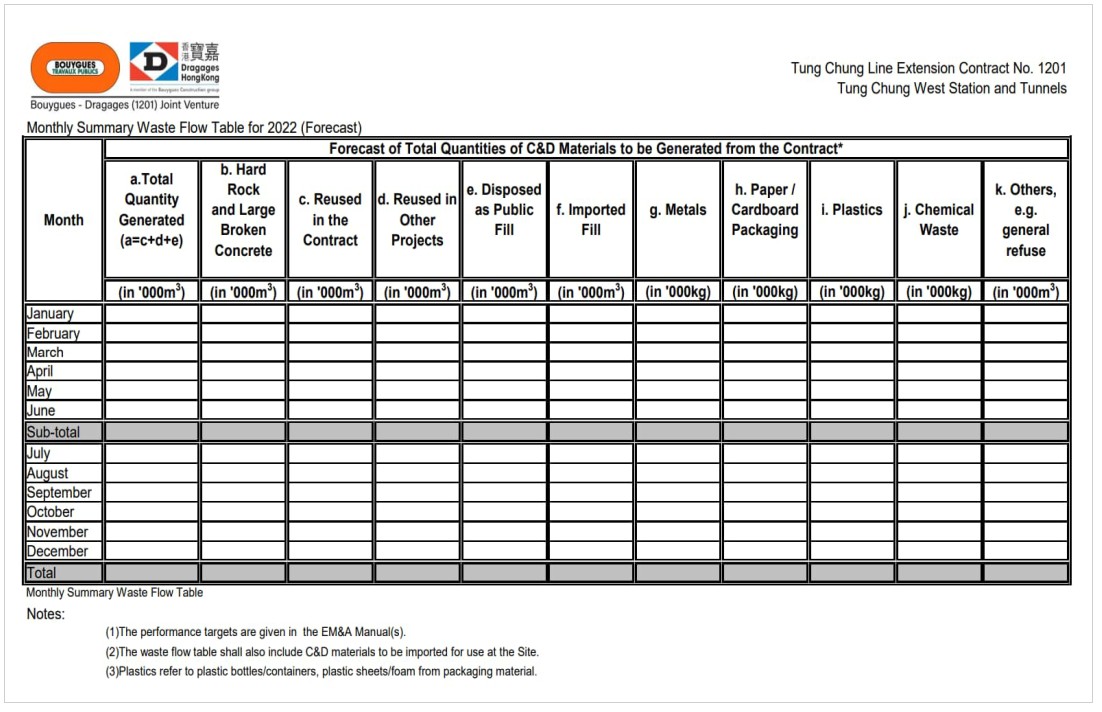
Waste Flow Table – Monthly
Record of the quantities of C&D materials generated each month will be maintained using the monthly summary Waste flow Table (WFT). The BDJV will complete and submit the monthly summary WFT to the Project Proponent by not later than the 15th day of each month follows the reporting month, or if it is a General Holiday, the day following the General Holiday.
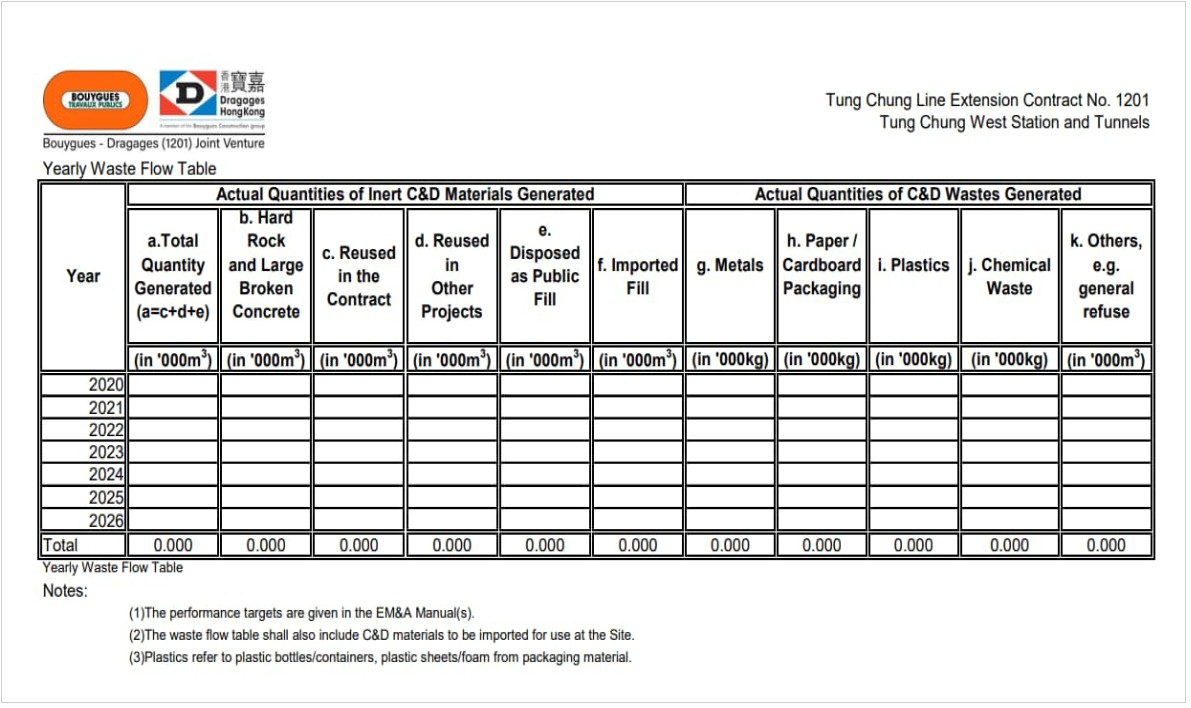
Waste Flow Table – Yearly
The estimated quantities of C&D materials to be generated each year from the site will be summarised using the yearly summary WFT. The WFT will be updated on a half-yearly basis and submit to the Project Proponent by not later than 1st of June and December of each year, or if it is a General Holiday, the day following the General Holiday, throughout the construction period in order to account for the revised works programme and latest outturn on the quantities of C&D materials generated from the site.
Summary Table – Timber Usage
A method statement will be submitted to the Project Proponent if the use of timber for temporary works construction for one process / activity with an estimated quantity exceeding 5 m3.
A timber usage summary table which contains the description, justification and the estimated quantity for every work process / activity requiring the use of timbers for temporary works construction irrespective of the quantity of timber used will be updated and submitted to the Project Proponent together with the monthly summary WFT for monitoring and review.
Specific trip tickets and records for the internal transfer of C&D materials will also be kept for monitoring and shall be made available to the PMD upon request.
For recyclable materials, BDJV’s Representative will record the quantities of recyclable materials before removal off the Site via recycling contractors, and also include the details in the WFT for submission to the PMD.
Waste Flow Verification
In order to ensure the proper disposal of C&D materials that are generated during the course of the contract, the following enhancement measure to improve the TTS recording system will be utilised:
A video recording system will be installed onsite by BDJV and disposal records shall be checked against the survey record. The video recording system shall also be used to monitor the vehicular exit / entrance of the site.
9. Waste Monitoring and Action Plan
The aims and objectives of the waste management audit program are:
§ To ensure that waste generated by the works is handled, stored, collected, transported and disposed of in accordance with the applicable environmental guidelines and regulations.
§ To ensure that the handling, storage, collection and disposal of waste arising from the demolition works complies with the relevant requirements under the WDO and its regulations, and this WMP.
§ To encourage the reuse and recycling of materials.
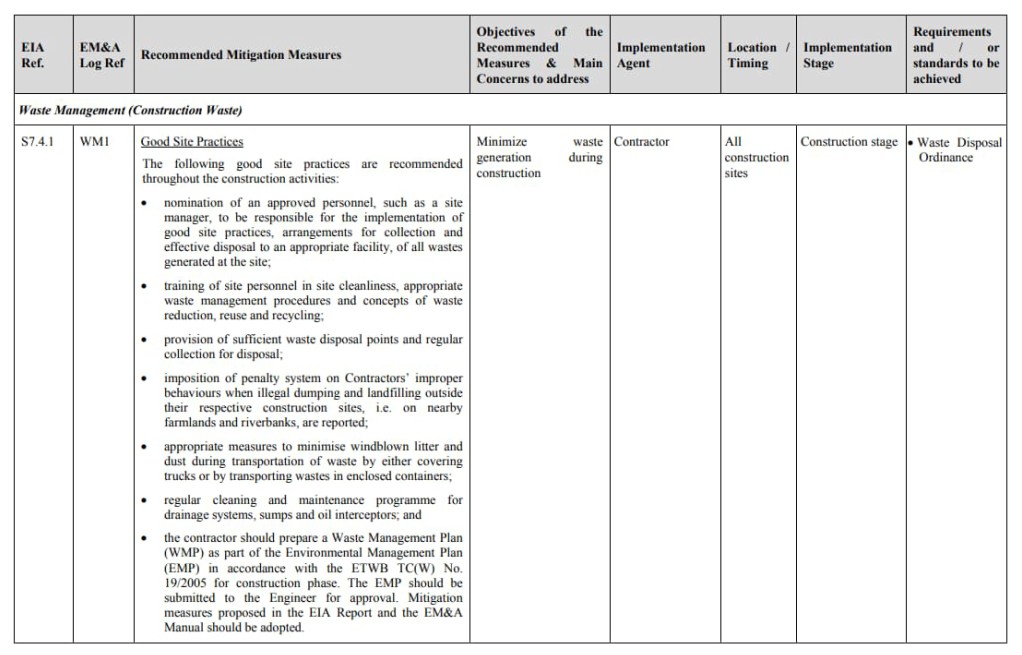
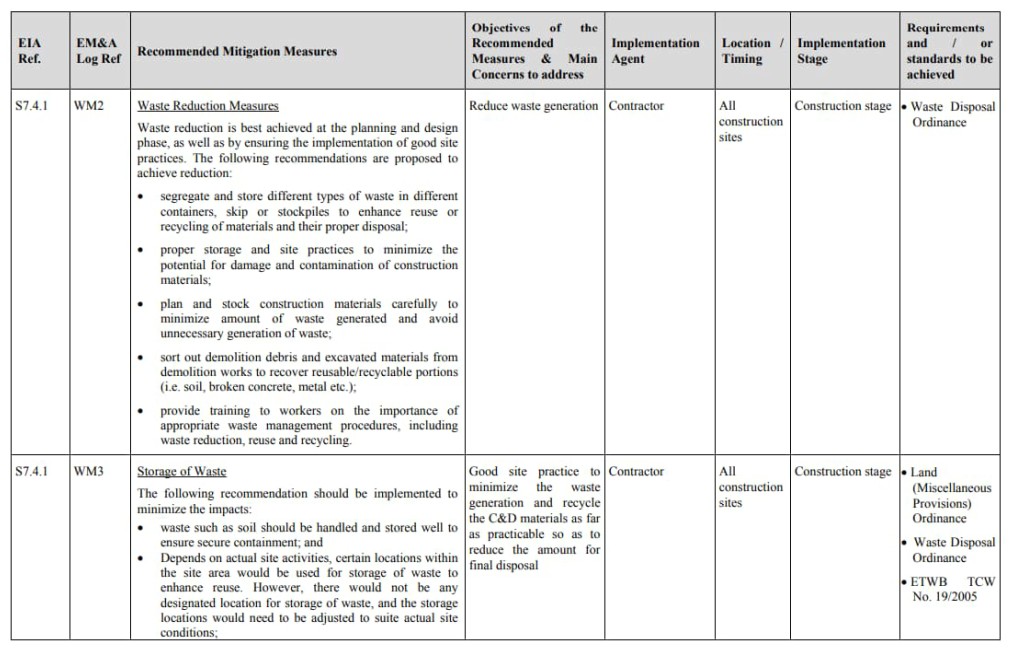
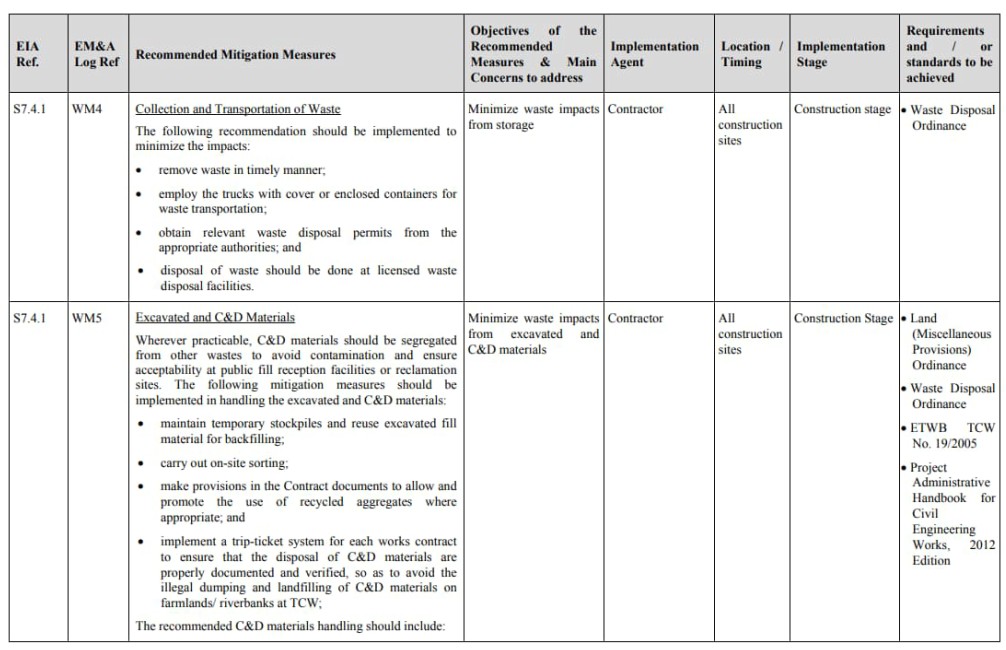
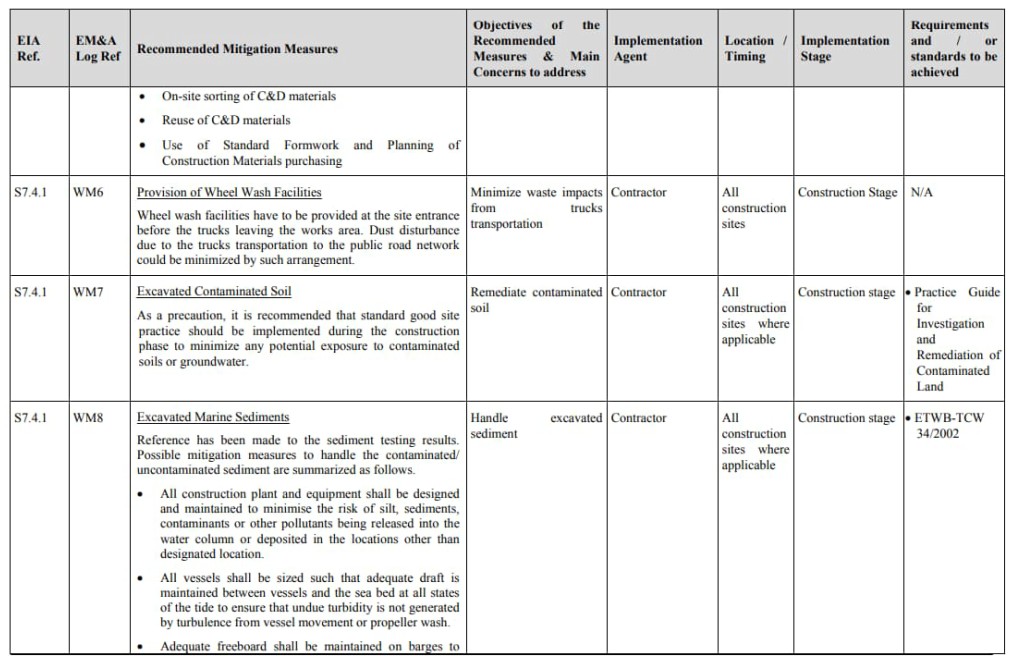
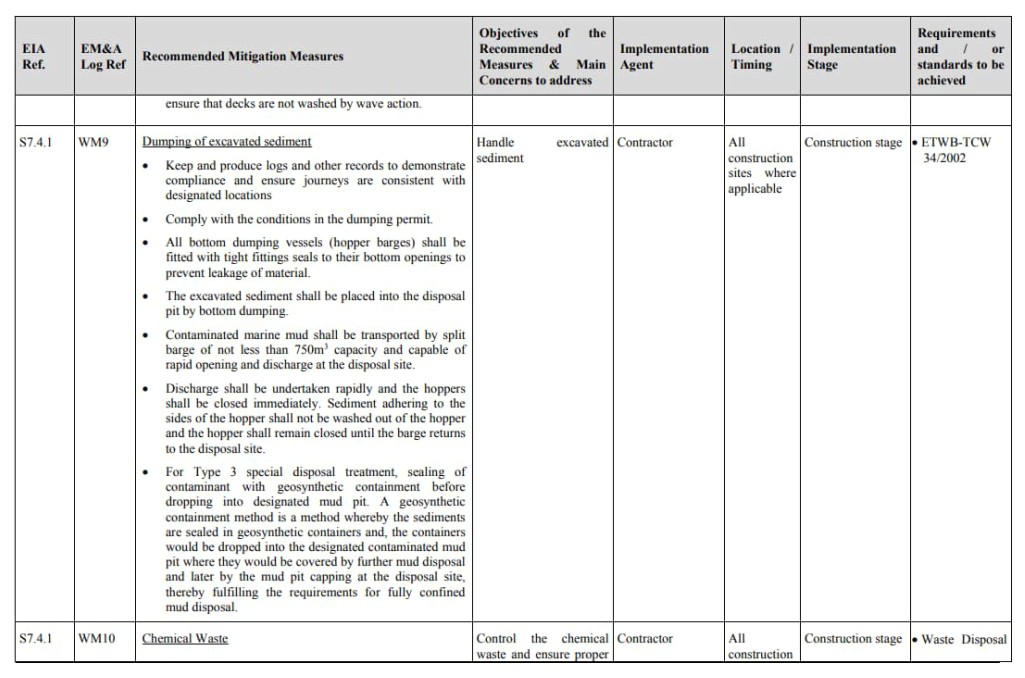
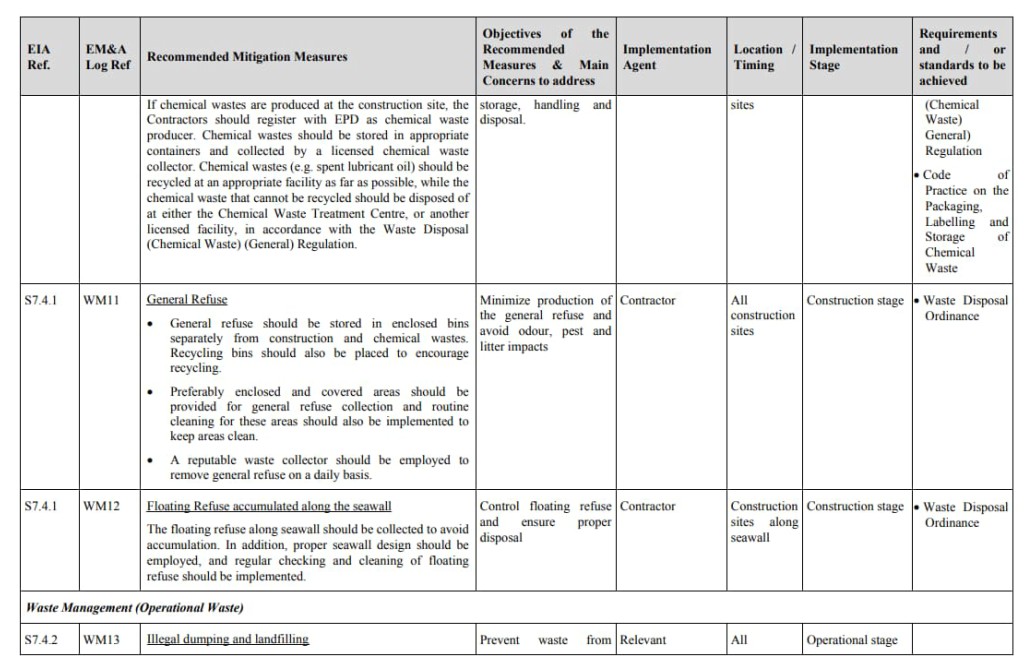
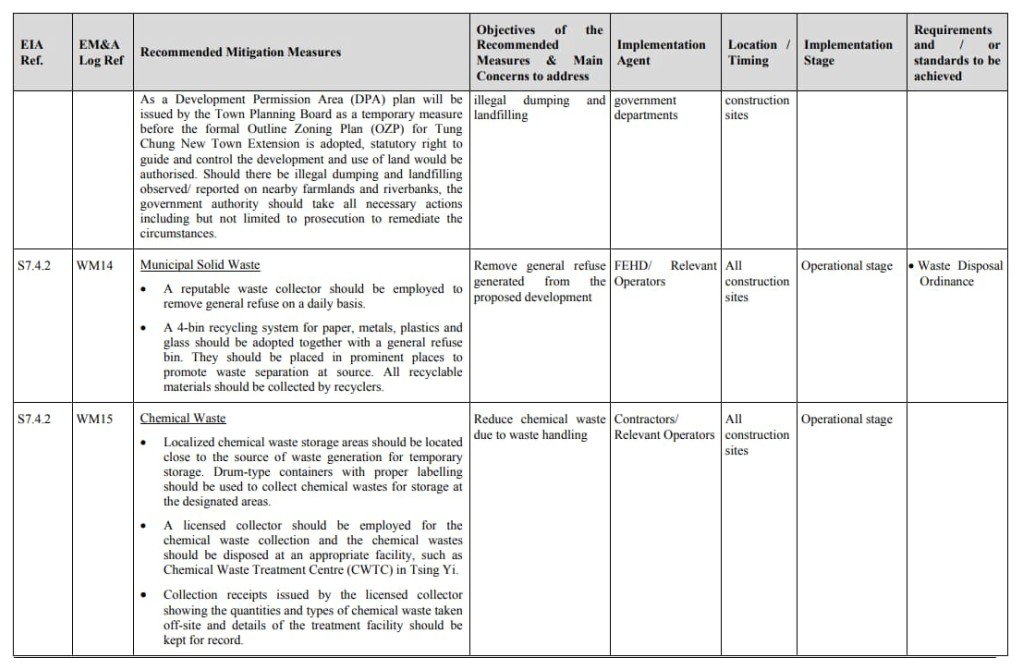
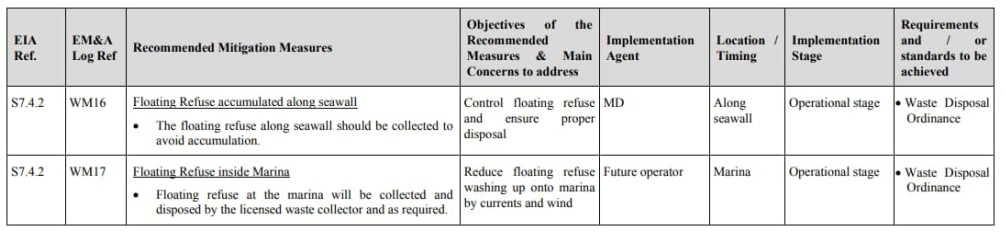
The EO, with assistance from the PD or DPD, will conduct audits of the waste management practices during the weekly environmental site inspection to evaluate the overall implementation of the WMP, and to ensure that the appropriate control measures are properly implemented. The results of the waste management audits will be reported in the monthly EM&A reports. The Environmental Mitigation Implementation Schedule (EMIS) of the Tung Chung New Town Extension EM&A Manual (AEIAR-196/2016) is given in Appendix B.
In the event of any non-compliance observations or complaints against the provisions of this WMP, appropriate actions will be taken according to the particular event. An Action Plan for non-compliance and complaints is shown in the following tables:
9.1. Surveillance Team
A surveillance team, designated under EP condition 2.6, will conduct regular site inspections to identify and report immediately to the IEC, the ER and the Director on any suspected illegal dumping and landfilling of C&D materials within Project site throughout the construction phase.
Table 11.1: Event Action Plan for Non-compliance
|
Step |
Day |
Action |
Construction Team |
Env. Officer |
|
1 |
1 |
A non-compliance record will be created within one (1) working day of making the observation during a site audit. The EO will send a Non-Compliance Report (NCR) to Construction Team. The NCR would include details of the observation/s, the time and location of the observation/s and the reason/s for the non-compliance.
|
|
X |
|
2 |
2 |
The Construction Team will propose suitable corrective action/s to mitigate the non-compliance observed within Three (3) working day of receipt of the NC from the ET. |
X |
- |
|
3 |
3 |
The EO will review BDJV’s proposed corrective action/s and make additional recommendations as necessary. |
- |
X |
|
4 |
- |
The Construction Team will implement the proposed corrective action/s once they have been agreed to by all parties. |
X |
- |
|
5 |
- |
The implementation of the corrective action/s will be checked at the next site audit. Close the NC if the implementation of the corrective action/s is satisfactory. |
X |
X |
|
6 |
- |
Construction Team will propose preventive action/s within three (3) working days of the closure of the NC. |
X |
- |
|
Note: "x" denotes action party comments on the NC where applicable. |
||||
Table 11.2: Event Action Plan for Complaint
|
Step |
Day |
Action |
Construction Team |
EO |
|
1 |
1 |
The EO will investigate validity of complaint, and assess whether the complaint is due to an onsite activity. If the complaint is valid and due to site activity, the EO will log details of the complaint into a Complaint Register (CR). |
- |
X |
|
2 |
2 |
Construction Team will assess the CR and propose suitable mitigation measures. |
X |
X |
|
3 |
3 |
The EO will review the mitigation measures and agree or propose further mitigation measures if required. |
- |
X |
|
4 |
- |
Construction Team will implement the proposed mitigation measures once they have been agreed to by all parties. |
X |
- |
|
5 |
- |
The EO will check the implementation of the mitigation measures during the next site audit. The EO will close out the compliant, if the implementation of the mitigation measures is satisfactory. |
X |
X |
|
6 |
- |
Construction Team will propose suitable prevention measures within three (3) working days after closure of the compliant. |
X |
- |
|
Note: "x" denotes action party comments on the NC where applicable. |
||||
10. Waste Management Audit
The aims of the waste audit are:
§ To ensure proper arrangements/procedures to avoid/minimize the waste generated from construction activities;
§ To ensure that the waste arising from works are handled, stored, collected, transferred and disposed of in an environmentally acceptable manner;
§ To ensure that the handling, storage, collection and disposal of waste arising from the demolition works comply with the relevant requirements under the Waste Disposal Ordinance and its regulations;
§ To ensure on-site sorting of C&D materials is properly carried out to recover inert C&D materials and reusable and/or recyclable materials before disposal;
§ Plastic bottles/containers or plastic sheets/foam from packaging are collected as far as possible for recycling;
§ Inert C&D materials suitable for recycling into aggregates are recovered and delivered to recycling facility;
§ To encourage the reuse and recycling of inert C&D materials; and
§ To facilitate the Project Proponent to audit the JV’s performance in implementing the WMP.
Site inspections provide a direct means to trigger and enforce the specified environmental protection and pollution control measures. Site inspection will be undertaken weekly by the Engineer and attended by the BDJV and Environmental Officer to inspect the Site to ensure satisfactory performance on compliance with this Waste Management Plan.
APPENDIX A – Project Layout Plan
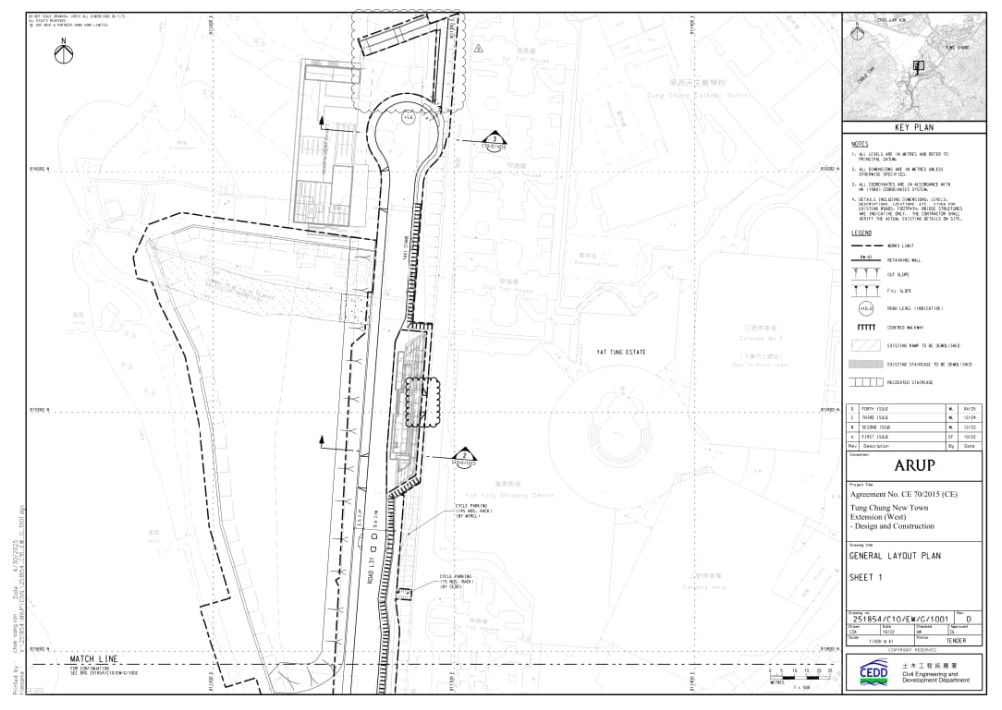
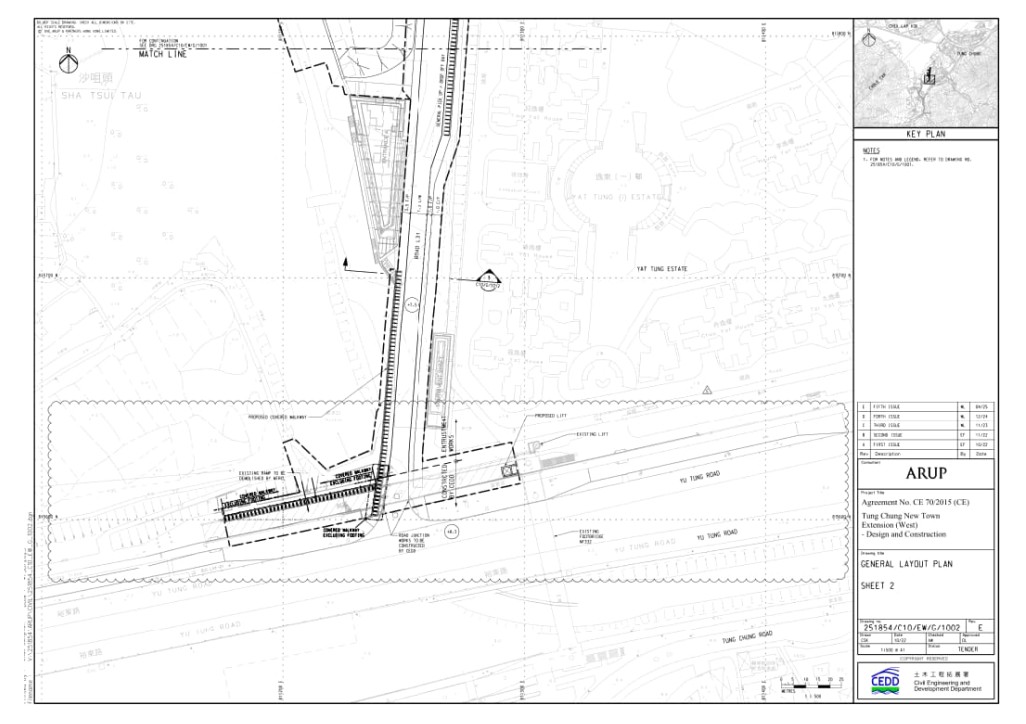
APPENDIX B – Environmental Mitigation Implementation Schedule (EMIS)
APPENDIX C –Notification to Truck Driver
APPENDIX D –Trip Ticket System Flow Chart
APPENDIX E –Daily Record Summary of C&D Material template and Sample of Trip Ticket
|
1. |
Scope of Work |
|
|
· Stockpiling · Transportation of Excavated Materials · Transportation of Other Construction Waste |
|
2. |
Construction Sequence of Works |
|
2.1 |
Stockpiling: · The excavated material generated from excavation will consist of soil and rock materials which will, as far as practicable, be reused on-site for the backfilling works. · Excavated material will also be generated from foundation work, underground services works and even any temporary works for excavation. Any surplus excavated material will be temporary stored in a designated area and would be engaged for backfilling · The spoil will be stored at 2m high maximum and slope surface will be kept in 1:2. · When amber rainstorm signal or higher is hoisted, protective measures would be provided on slope surface against rainwater such as covered with tarpaulin or plastic sheet, erecting the temporary shelters, additional of pumps to drive out rainwater, etc.. |
|
2.2 |
Transportation of Excavated Materials · The excavated material will be sprayed with water when it is dry. The aim is to control dust in work area · Dump truck loaded with excavated materials would be covered by tarpaulin sheeting or mechanical cover to prevent dust emission. · For the transportation of excavated materials, BDJV will implement and comply with the requirements of the Trip-Ticket System (TTS) stipulated in Development Bureau Technical Circular (Works) No. 6/2010. |
|
2.3 |
Transportation of Other Construction Waste - General refuse and C&D materials · Un-recyclable, non-inert C&D Materials, i.e. general refuse, which mainly consists of food waste, aluminum cans and waste paper, will be generated from construction activities, workers and the site office. · The C&D Materials will be temporarily stored and containers or skips will be provided for temporary waste storage to prevent odour, pest and windblown litter · Office waste will be reduced through the recycling of paper. Sacks for wastepaper and baskets for reusable papers will be provided in the Site Office. General refuse including food and domestic waste will be stored in enclosed bins or compaction units separate from the construction and chemical waste. Lunch boxes, plastic bottles, containers and plastic sheets will be sorted and stored in separately labelled bins for subsequent recycling. The waste will be recycled by sending to the government recycling facility such as the Community Green Station operated by the EPD. · The general refuse and the un-recyclable C&D Materials will be collected and disposed of on a regular basis to minimize the likelihood of odour, pests and litter. They will be transported and disposed of by a licensed waste hauler. A trip-ticket system to trace the transportation and destination of the waste will be implemented and the burning of refuse on the site will be strictly prohibited. |
|
|
- Chemical waste · For chemical waste produced by a process, as defined by Schedule 1 of Waste Disposal (Chemical Waste)(General) Regulation, a ‘Chemical Waste Producer’ registration will be made with EPD. · Chemical waste is likely to be generated during maintenance of plant and equipment, and these may include asbestos waste, used mechanical oil, cleaning fluid, spent solvents, lubricating oil and paints and paint containers. · All chemical waste generated on site will be stored and labelled in accordance with the Code of Practice on the Packaging, Labelling and Storage of Chemical Waste published by the EPD. All workers involved in the handling of chemical waste will be trained properly and will be provided with appropriate clothing. · The sorting and segregation of chemical waste will be carried out on site to ensure the waste is appropriately handled, labelled and treated prior to disposal off-site. The recoverable chemical wastes such as oil, paint and solvent, will be separated from other chemical wastes and EPD licensed chemical waste collector will be employed to collect the chemical waste. · Chemical waste will be stored at designated storage areas in accordance with the Code of Practice on the Packaging, Labelling and Storage of Chemical Waste. The containers to be used for the storage of chemical waste will: Ø Be suitable for the substance they are holding, resistant to corrosion and be maintained in a good condition and kept securely closed; Ø Have a capacity of less than 450L unless the specifications have been approved by the EPD; and Ø Display a label in English and Chinese in accordance with instruction prescribed in Schedule 2 of the Regulations. · The storage area for chemical waste will: Ø Be clearly labelled and used solely for the storage of chemical waste; Ø Be enclosed on at least three sides; Ø Have an impermeable floor and be bunded to accommodate 110% of the volume of the largest container or 20% by volume of the chemical waste stored in that area, whichever is greater; Ø Have adequate ventilation; Ø Be covered to prevent rainfall entering (water collected within the bund must be tested and disposed as chemical waste if necessary); and Ø Be arranged so that incompatible materials are adequately separated. · All producers of chemical waste (including asbestos) must register with EPD and treat their waste either utilizing on-site plant licensed by EPD or arranging for a licensed collector to take the waste to a licensed facility. The trip-ticket system will be strictly implemented to ensure the chemical waste is transported by and to ensure the chemical waste is transported by and to proper agents. Trip tickets issued for every chemical waste collection will be retained and filed for future reference and inspection. |